Free Bets Explained: How They Work and How to Use Them (2026)
Free bets are tokens a bookmaker credits to your account that let you place a bet without staking your own money. Most are "stake not returned", which means you keep the winnings but not the free stake itself, so a £10 free bet at evens pays £10, not £20. Used carefully, that £10 token converts into £7–£8 of actual cash through matched betting.
The gap between £6 and £9 from the same free bet comes down to type, odds, and which bookmaker issued it. This guide covers the mechanic from inside the bookmaker, the maths that separates one type from another, and the practical steps for getting cash out of one.
Offer T&Cs change frequently. Always check before betting. Last verified: 2026-05-11.
Summary
- Free bets are bookmaker tokens, not cash. You can't withdraw them directly.
- Two main types exist: stake not returned (SNR) and stake returned (SR).
- SR is worth more pound for pound, but it's rarer and usually a reload reward rather than a welcome offer.
- UK welcome offers are almost all SNR, structured as "bet £10, get £30 in free bets".
- Free bets typically expire in 7 to 30 days and come with minimum odds, usually evens (2.0).
- Matched betting turns a £10 SNR free bet into £7–£8 of cash, win or lose, using the standard calculator in free-bet mode.
- Free-bet profits in the UK are tax-free; HMRC treats them as gambling winnings with nothing to declare.
That's the headline. The rest is the small print, because the small print is where most of the value sits, and where most beginners give a chunk of it back to the bookmaker.
What a free bet actually is
A free bet is a credit on your bookmaker account that funds a single bet at a specified maximum size. It isn't cash. You can't move it to your bank, transfer it to another bookmaker, or usually split it across multiple wagers.
What you can do is place the bet, wait for the result, and (if it wins) keep some or all of the winnings. The amount you keep depends on the type of free bet, which is the part most explainers wave through too quickly.
A few practical points first.
Free bets sit in a separate "free bet" balance, distinct from your withdrawable cash balance. You select the token when building your bet slip.
They almost always expire if unused. The typical window is 7 to 30 days for welcome offers, sometimes shorter for daily promos.
They usually come with minimum odds, most commonly evens (2.0). The reason is structural: bookmakers don't want you placing a £30 free bet on a 1.05 sure-thing and walking away with £1.50 of profit.
The winnings, if any, drop into your cash balance and become withdrawable.
Free bets are part of every major UK bookmaker's marketing budget. The next section is why.
Why bookmakers give free bets away
The "free bet" framing is generous. The reality is less so.
I spent two years on the customer-services desk at a UK high-street bookmaker before moving over to matched betting full-time in 2021. The internal framing of welcome free bets is straightforward: they're a customer-acquisition cost, costed to the penny against expected lifetime value. The free bet is a calibrated fraction of what a new sign-up is worth over the first 24 months.
The classic shape, "bet £10, get £30 in free bets", isn't accidental. The £10 qualifying bet seeds the bookmaker's bankroll with your money and gets you past the small psychological hump of clicking "place bet" for the first time. The free bets are the carrot that pulls you back for a second, third, fourth visit. After that the customer-acquisition phase is over and the lifetime-value clock starts ticking.
Two quiet design choices follow. The 1.5+ or 2.0+ minimum-odds rule on the free bet isn't arbitrary: at those odds the bookmaker's expected payout is bounded by their internal margin on the underlying market. And stake-not-returned by default exists because returning the stake on every promotional bet would roughly halve the cost-effectiveness of the promotion.
None of that makes free bets bad. Used carelessly they're worth perhaps 20–40% of their face value to the average punter; used carefully (which is what matched betting is) they're worth 70–95%. The bookmakers tolerate that gap because the long tail of customers who stay and lose more than covers the short tail who extract value early.
Stake not returned (SNR): what it means
A stake not returned free bet, usually abbreviated SNR, pays you the winnings only. The original stake stays with the bookmaker.
The simplest way to see this is with a single bet. Imagine a £10 free bet placed at evens (decimal odds 2.0):
- A cash £10 bet at 2.0 wins, you get £20 back: £10 stake plus £10 profit.
- A £10 SNR free bet at 2.0 wins, you get £10 back: just the £10 profit.
That's the SNR mechanic in one line. The stake "isn't returned" because it wasn't your stake to begin with. The bookmaker gave you a token, and the token effectively vapourises once the bet is placed.
Three implications follow.
The odds you pick matter a lot. A £10 SNR free bet at 1.5 returns £5 if it wins. The same £10 SNR free bet at 5.0 returns £40. That's an eightfold difference in return from the same token, and it's the biggest decision most punters never realise they're making.
The conversion-to-cash percentage through matched betting is usually 70–85%. The standard calculator handles the maths once you switch the Bet Type to Free Bet (SNR). The intuition is that you sacrifice about 15–25% of the free bet's face value as the cost of guaranteeing a result: the small spread between back and lay odds, plus exchange commission.
SNR welcomes are how virtually every major UK bookmaker structures their main sign-up promotion. Bet365, William Hill, Sky Bet, Paddy Power, Coral, Ladbrokes, Betfair Sportsbook, all SNR. There are exceptions in reload offers, but the welcome layer is overwhelmingly uniform.
Stake returned (SR): what it means
A stake returned free bet, or SR, pays out the full amount you'd have won on a cash bet, including the stake portion.
Same example:
- A £10 SR free bet at 2.0 wins, you get £20 back: the full equivalent of a normal £10 bet at evens.
SR is more valuable than SNR for the same face value because the stake isn't being silently clipped. Through matched betting, a £10 SR free bet typically converts to about 90–95% of face value. That's roughly £9 to £9.50 in your hand from a £10 token, against £7 to £8 for an SNR equivalent.
SR free bets are uncommon in the UK. They mostly appear in "risk-free" first-bet refund offers, where a losing qualifying bet is refunded as a stake-returned bonus, and in some bookmaker-specific reload rewards. The type isn't always advertised on the front page. The check that works is the T&Cs: if you keep the qualifying stake when you win, it's SR; if you only keep the profit, it's SNR.
SNR vs SR: a side-by-side worked example

Standard calculator Bet Type dropdown showing only Standard Bet and Free Bet (SNR), no SR mode option
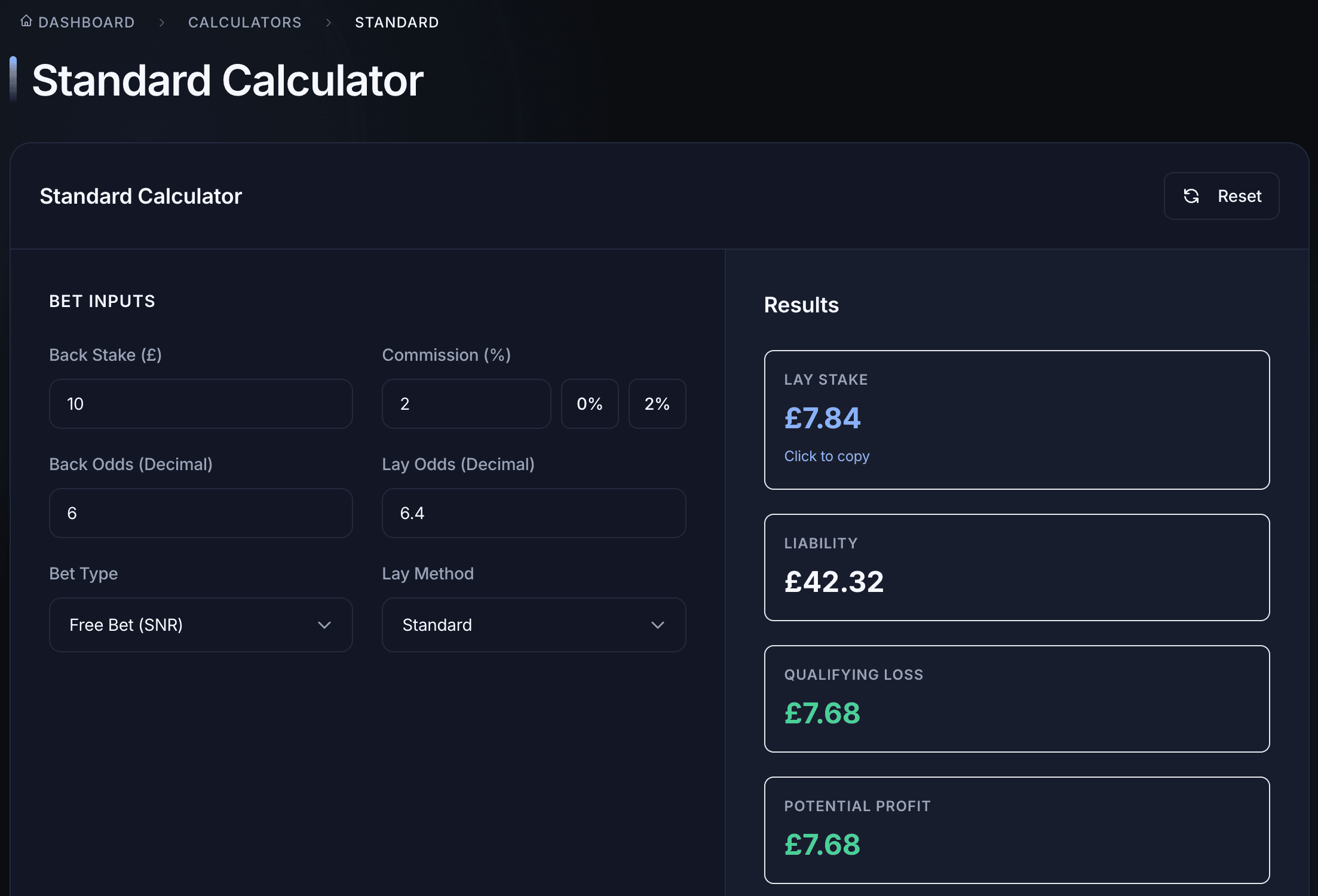
Better Bet standard calculator in Free Bet (SNR) mode showing a £10 free bet at 6.0/6.4 returning £7.67 of locked-in profit
Two £10 free bets, two different types, side by side. All numbers assume a Smarkets exchange at 2% commission.
Scenario 1: £10 SNR free bet on a Bet365 welcome. Back at 6.0 on a horse race, lay at the exchange at 6.4 (a typical back–lay spread on a mid-tier UK weekend market). Run the numbers through our standard calculator with Bet Type set to Free Bet (SNR):
- Back stake: £10 (free bet, SNR)
- Lay stake (calculator output): £7.84
- Lay liability: £42.34
- Net profit if back wins: £7.66
- Net profit if lay wins: £7.68
- Locked-in profit: ~£7.67 (76.7% of the £10 face value).
Scenario 2: £10 SR free bet on a stake-returned refund. Back at 3.0 on a Premier League market, lay at the exchange at 3.10. The standard calculator doesn't currently have a dedicated SR mode, so this row is a manual calculation using the same lay-stake formula:
- Back stake: £10 (free bet, SR)
- Lay stake (manual): £9.74
- Lay liability: £20.45
- Net profit if back wins: £9.55
- Net profit if lay wins: £9.54
- Locked-in profit: ~£9.55 (95.5% of the £10 face value).
| Free bet | Back odds | Lay odds | Net profit | % of face value |
|---|---|---|---|---|
| £10 SNR | 6.0 | 6.4 | £7.67 | 76.7% |
| £10 SR (manual) | 3.0 | 3.10 | £9.55 | 95.5% |
Our standard calculator doesn't currently include an SR-mode toggle because SR free bets are rare in the current UK market. Most welcome offers and reloads are SNR. The £9.55 / 95.5% figure is calculated manually using the same lay-stake formula a calculator would apply if SR mode existed: lay stake = back stake × back odds / (lay odds − exchange commission).
The 18-percentage-point gap between SNR and SR is the structural difference between the two types. It also points at the unintuitive but reliable rule for SNR: pick higher odds.
The intuition is that you're being given a £10 ride on the bookmaker's stake, and you want the ride to be as long as possible. A £10 SNR free bet at 2.0 maxes out at £10 in winnings. The same £10 SNR free bet at 8.0 maxes out at £70, and after laying the position cleanly it returns substantially more cash. Most punters' instinct is to play it safe at short odds because they don't want to lose the free bet. That instinct is exactly backwards.
The first time I ran an SNR free bet through this calculator after leaving the bookmaker side, in early 2021, the lay odds drifted by a tick while I was clicking. The conversion came back at £6.94 from a £10 Bet365 SNR free bet at 5.5 / 5.8 odds, when the calculator had predicted £7.63. The 69p difference is the discipline of placing both legs quickly and not refreshing the lay side at the wrong moment. Everyone gives a bit of it back the first few times.
Which UK bookmakers use which type
The table shows the current state of the main UK welcome offers as of 2026-05-11. Offer details change weekly, sometimes daily, so cross-reference with the bookmaker's live page (or our UK bookmaker hub, which tracks the structure and gubbing-risk profile of each) before signing up.
| Bookmaker | Welcome offer shape | Type | Qualifying min odds | Free-bet min odds |
|---|---|---|---|---|
| Bet365 | Bet £10 → £30 in free bets | SNR | 1.50+ | none stated |
| William Hill | Bet £10 → £30 free bet | SNR | 1.50+ | 1.50+ |
| Sky Bet | Bet £5 → £30 in free bets | SNR | 2.00+ | 2.00+ |
| Paddy Power | Bet £10 → £40 in free bets | SNR | 2.00+ | 2.00+ |
| Betfair Sportsbook | Bet £10 → £30 in free bets | SNR | 1.50+ | 1.50+ |
| Coral | Bet £5 → £20 in free bets | SNR | evens+ | evens+ |
| Ladbrokes | Bet £5 → £20 in free bets | SNR | evens+ | evens+ |
| BetVictor | Bet £10 → £40 free bets | SNR | 2.00+ | 2.00+ |
| 888sport | Bet £10 → £30 free bets | SNR | 1.50+ | 1.50+ |
A few observations.
Every welcome offer is SNR. That's the architecture: cheap to the bookmaker, just enough value to the customer to feel meaningful. Typical face values are £20 to £40, often split across several smaller tokens.
Qualifying-stake minimum odds cluster around 1.50 to 2.00. That's the bookmaker keeping their cost-per-acquisition predictable. A £5 qualifying bet at 1.05 wouldn't unlock the offer.
Free-bet minimum odds vary. Bet365 sets none explicitly, which is unusual. Sky Bet and Paddy Power both require 2.00+. The minimum doesn't change the maths much for matched betting because higher odds win anyway. It does rule out the "stick the free bet on a 1.20 favourite" strategy a lot of casual punters default to.
SR free bets exist in this market but mostly as reload rewards. The reload deck varies more; the welcome deck is overwhelmingly uniform.
The Gambling Commission's Licence Conditions and Codes of Practice require bookmakers to present these terms clearly. UK majors generally comply. If a bookmaker's T&Cs feel deliberately confusing, that's a flag worth raising with the Advertising Standards Authority, which has a history of upholding rulings against gambling adverts that misled on the "free" framing.
How to turn a free bet into actual cash
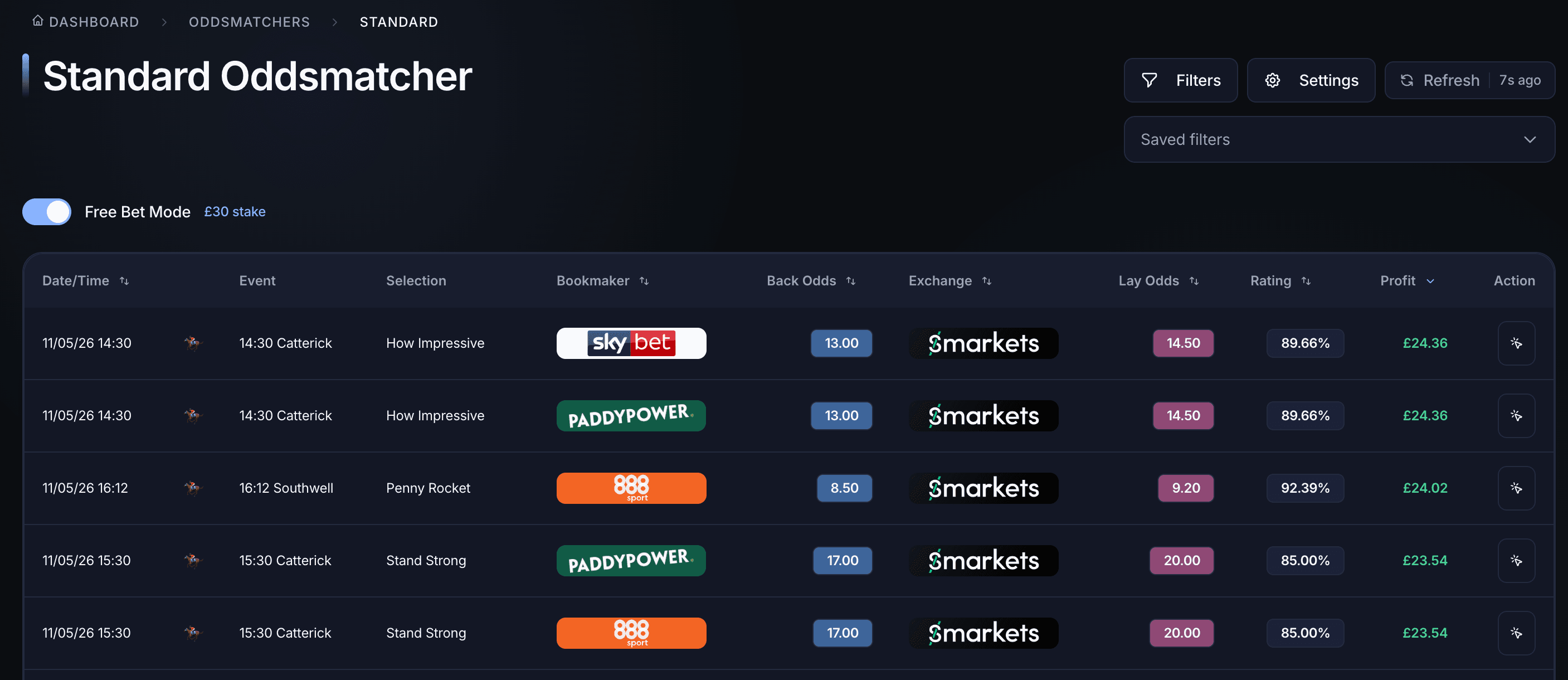
Better Bet standard oddsmatcher showing today's top free-bet conversion opportunities ranked by rating
The matched-betting method for extracting a free bet's value is the same regardless of bookmaker or offer type. Four steps.
1. Place the qualifying bet. This is the back-and-lay pair on real cash before the free bet is credited. Find a market where the bookmaker's back odds and the exchange's lay odds are close. Open the standard matched betting calculator, drop in the back stake, the back odds, the lay odds and the exchange commission. The calculator returns the lay stake. Place both bets within a couple of minutes of each other so the odds don't drift far. Net cost of the qualifying bet is typically £0.20 to £0.80 on a £10 stake.
2. Wait for the free bet to credit. Most UK bookmakers credit free bets within minutes of the qualifying bet settling. A few take up to 24 hours. The token appears in the dedicated "free bets" section of your account.
3. Place the free-bet leg. Switch the standard calculator's Bet Type to Free Bet (SNR). Enter the free bet's value, the back odds (higher is usually better for SNR), the lay odds and the exchange commission. The output is the lay stake required to leave the same profit whatever happens on the pitch. For a (rare) SR free bet, calculate the lay stake manually using the formula in the worked-example note above.
4. Place the bets and let them settle. Whether the back bet at the bookmaker wins or the lay bet at the exchange wins, the net result lands the same. For a £10 SNR free bet at sensible odds, that's £7 to £8. For a £10 SR free bet, around £9 to £9.50.
The standard oddsmatcher is what most matched bettors use to find both legs without scanning every bookmaker page manually. It compares every UK bookmaker market against the matching exchange market in real time and ranks them by closeness of odds.
A couple of qualifications. The technique is completely legal in the UK; the Gambling Commission regulates the bookmakers and exchanges, not the customers who use them. The profits are tax-free in the UK: HMRC treats them as gambling winnings, with no Income Tax, no National Insurance, nothing to declare.
If you've not tried the underlying mechanic before, our matched-betting beginner guide walks through it in more depth, and today's sign-up offers is the live list of bookmaker welcomes worth working through this week.
Wagering, expiry and the rest of the small print
A free bet's actual value is the face value minus everything you give back through the T&Cs. The big-ticket items are wagering, expiry, and excluded markets.
Wagering requirements. Most UK sportsbook free bets have no wagering attached: place the bet, the winnings drop into your cash balance, you can withdraw. Casino offers are different. A casino bonus typically has a wagering requirement of 20× to 50× the bonus amount, meaning you must turn over the bonus that many times in qualifying play before any winnings become withdrawable. A £20 casino bonus at 30× wagering needs £600 of qualifying turnover. Sportsbook free bets and casino bonuses look similar but the maths is very different.
Expiry. Welcome free bets are usually valid for 7 to 30 days from credit. Reload free bets are often shorter, particularly daily promos tied to a specific event. The clock starts when the token is credited, not when the offer is claimed.
Excluded markets. A few bookmakers exclude specific markets from free-bet placement. Bet Builders, anytime goalscorer, and certain in-play markets are common exclusions. The list is in the offer T&Cs and can be enforced retroactively.
Cash out. You generally can't cash out a free-bet selection. Once placed, it runs to settlement.
Stake size. The free bet must usually be placed as a single bet at the credited face value. A £30 free bet placed as three £10 bets is sometimes allowed, sometimes not.
One per household. Bookmakers detect and void duplicate sign-ups ruthlessly. Multiple accounts from the same address, payment method, or device usually get flagged within hours.
Played within the T&Cs, free bets are the most reliable source of matched-betting profit in the UK. Played outside them, you spend an hour on the offer and end up with a void bet and an annotated account. The site-wide footer covers the 18+ and safer-gambling reminders that apply to everything in this guide.
Frequently asked questions
Are free bets really free?
Not in the way the marketing suggests. The bookmaker commits the stake, but it's a calibrated customer-acquisition cost they've already priced in, not generosity. Used carefully through matched betting you do extract real cash: about 70–85% of an SNR free bet's face value, 90%+ for SR.
Can you withdraw a free bet without using it?
No. Free bets are tokens, not cash. They sit in your account until you place them on a qualifying market, and they expire unused after the offer window closes. The T&Cs of every major UK bookmaker are explicit on this.
How long do free bets last before they expire?
It varies. Welcome free bets are usually valid for 7 to 30 days from credit. Daily reload offers can be 24 hours. Sky Bet Club weekly free bets expire in seven days. Always check the offer page T&Cs.
Do I have to bet on the same sport that earned the free bet?
Sometimes. Football-specific welcome offers (Sky Bet's Premier League welcome, some Paddy Power football promos) require the free bet to be placed on football. General welcomes (Bet365, William Hill) usually let you place the free bet on any sportsbook market that meets the minimum-odds rule.
Are free-bet winnings taxable in the UK?
No. HMRC treats gambling winnings as non-taxable income, and free-bet winnings sit in the same bucket. Our tax guide covers the detail, including why the £1,000 trading allowance doesn't apply.
What's the difference between a free bet and a bonus bet?
In UK use the terms are largely interchangeable on the sportsbook side. A bonus bet tends to mean a deposit-matched casino balance with wagering attached; a free bet typically means a sportsbook token with lighter restrictions. American sites use "bonus bet" for what UK sites call a free bet, which is one source of confusion in older guides.
The practical takeaway
Free bets are the most reliable matched-betting income source in the UK, particularly during the sign-up phase before bookmakers start watching new accounts properly. The maths is consistent: roughly 77% of face value from an SNR free bet at sensible odds, around 95% from an SR. Bookmakers tolerate that gap as a cost of customer acquisition.
If you've not tried the conversion before, the tutorial walks you through two real bookmaker free bets (a Sky Bet £30 and a Paddy Power £30) without asking for a payment card. Most members end the tutorial with around £40 in their bank account from those two offers alone, net of the qualifying losses. That's roughly what the SNR maths predicts when both offers run to plan.