Is Matched Betting Legal in the UK? (2026 Compliance Guide)
Yes. Matched betting is legal in the UK for anyone aged 18 or over. It uses promotions advertised by Gambling-Commission-licensed bookmakers, doesn't break any UK law, and no recreational matched bettor in the UK has ever been prosecuted for the activity.
There are still two things people regularly conflate, though, and both are worth ten minutes of your time before deciding whether to start.
Summary
- Matched betting is legal in the UK. It uses promotions as advertised by licensed bookmakers and exchanges.
- The UK Gambling Commission licenses operators, not customers. The activity itself isn't restricted by law.
- The Advertising Standards Authority has ruled on misleading marketing language ("100% risk-free" claims), not on matched betting itself.
- Bookmakers can close your account under their T&Cs, but that's a private commercial decision, not a legal sanction.
- No one in the UK has ever been prosecuted for matched betting; there is no offence to charge.
- The activity is age-restricted (18+), regulated at the operator level, and tax-free.
Why matched betting is legal
Matched betting works by placing two opposing bets on the same outcome (backing it at a bookmaker, laying it on a betting exchange) to cover every possible result. The technique is explained in full in our matched betting beginner guide, but the legal point is simpler than the maths.
Bookmakers offer promotions to attract new customers. They publish terms and conditions explaining who can claim, the qualifying stake, the free-bet amount, and how it must be wagered. When you read those terms, do exactly what they ask, and use the bookmaker's free bet on a market they advertise, you are using their product as offered. There is no UK statute that says you mustn't.
The maths is the only thing that distinguishes a matched bettor from any other punter. By covering both sides of the same event with sensibly-chosen lay odds at a betting exchange, you remove most of the variance. Our standard matched betting calculator does that calculation in seconds, with the rest of our matched betting calculators covering the trickier offer types.
The bet is still legal because the underlying transactions are legal. Two licensed operators (the bookmaker and the exchange) are processing two regulated bets, and you are choosing the stakes within their published rules.
What the Gambling Commission says
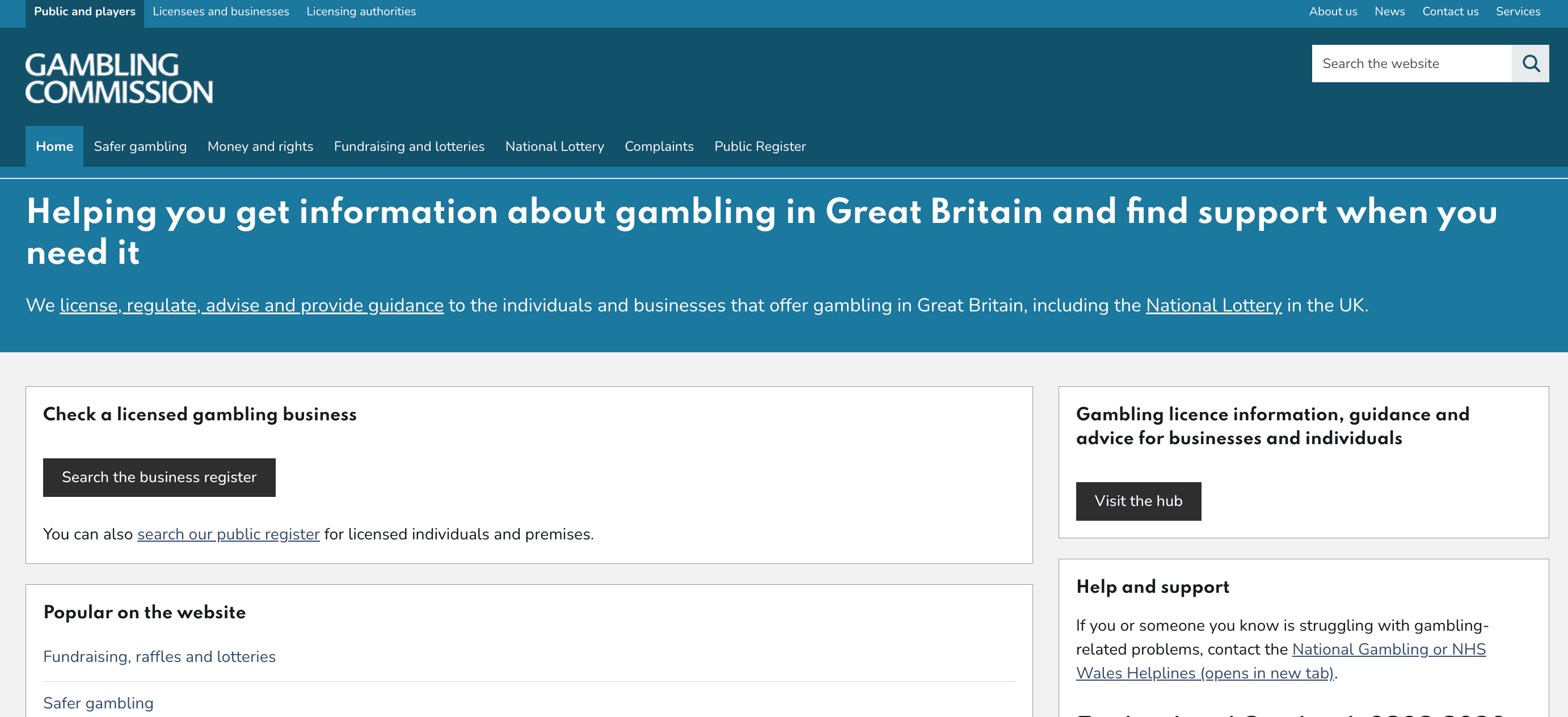
UK Gambling Commission website showing the licensed-operators register confirming bookmakers, not customers, are regulated
The Gambling Commission is the public regulator of UK gambling. Its remit is set out plainly on its own pages: "We license and regulate the individuals and businesses that provide gambling in Great Britain." That sentence is the key to the whole question.
Read it carefully. The Commission's remit is operators, not customers. Bet365, William Hill, Sky Bet, Paddy Power, Betfair and Smarkets are the businesses the Gambling Commission licenses, audits, fines and (occasionally) suspends. You, sitting in front of a free-bet sign-up, aren't a regulated operator. You're a consumer using a product the Commission has authorised the bookmaker to offer.
That distinction is the foundation for everything else. The Commission requires licensed operators to publish clear terms, honour them, treat customers fairly under its Licence Conditions and Codes of Practice, and route customer disputes through approved alternative dispute-resolution providers. None of those rules forbid you from using a published offer at the published terms. The Commission has not issued any guidance suggesting matched betting is restricted, problematic, or something it intends to regulate from the customer side.
Every well-known UK bookmaker on today's sign-up offers list holds a Commission licence. If you're matched betting at a licensed operator, on its published promotions, the entire chain is regulated. Regulated, specifically, in a way that doesn't require any licence from you.
What the ASA has ruled on
The Advertising Standards Authority is the UK regulator for misleading advertising. It has ruled on matched-betting ads three times in the past few years, and each ruling helps clarify why the activity itself is fine.
The ASA's advice page on matched betting is explicit: "ads for matched betting services are not gambling in themselves." That's the regulator confirming that promoting matched betting isn't promoting an illegal activity. The complaints they upheld were about the language of certain ads, not the practice underneath.
The three named cases:
- DotNetPages Ltd (OddsMonkey), 20 February 2019. An ad implying matched betting was risk-free was ruled misleading, on the grounds that "due to the complications of the processes involved, there was still a chance that individuals could lose money".
- Profit Accumulator Ltd (Bonus Accumulator), 14 October 2020. A similar finding on socially irresponsible language and unrealistic earnings.
- Grip Media Ltd (Save the Student), 5 April 2023. Inappropriate targeting of students alongside misleading earnings claims.
Each ruling sat under CAP Code Section 16, the gambling section, which forbids suggesting that gambling solves financial problems or replaces employment. None of the rulings restricted matched betting itself. The pattern is consistent: the ASA cares about how matched betting is advertised, and not at all about whether you, the reader, are allowed to do it.
I re-read all three rulings while drafting this. Every one turns on advertising language; not one questions the legality of the activity it describes. We use careful, specific phrasing across our content for exactly this reason.
"But isn't it cheating?"
The honest answer is no. A bookmaker offers a free bet to attract a customer. The customer signs up, places the qualifying bet, claims the free bet exactly as advertised, and uses it on a market the bookmaker has priced. Every step is the bookmaker's design.
The reason bookmakers don't love matched betting is the same reason supermarkets don't love extreme couponers: it eats into margin. That's a commercial complaint, not a moral or legal one. UK operators have built customer-acquisition cost into their pricing for years, and the promotional spend appears as a known line item in every public operator's annual report.
When I covered gambling regulation as a personal-finance journalist before joining Better Bet, "is matched betting illegal" or "is matched betting cheating" came up at every editorial meeting whenever the topic crossed the desk. The legal team's answer was always the same: it isn't, on either count. The regulators agree. The bookmakers might privately wish you wouldn't, but that's a different category of objection.
Bookmaker T&Cs vs UK law
This is the clarification most posts skip, and it's the reason a lot of people get confused.
A bookmaker can close your account, restrict your stakes, refuse you future free bets, withhold a marketing offer, or stop sending you weekly promotions. Their terms and conditions reserve all of those rights. If they decide your account is unprofitable for them, they can act on it. People in matched-betting communities call this getting gubbed.
That's a commercial decision, not a legal one. You haven't done anything criminal. You haven't been "caught" in any meaningful sense. You've been judged unprofitable by a private business and deprioritised. The Gambling Commission permits operators to manage their books that way within the LCCP and its consumer-fairness rules.
So when someone asks "is matched betting illegal in the UK?", what they often really mean is "could a bookmaker do something to me?" Yes, they can close your account. The answer to the legal question is still no. UK law doesn't treat using a published promotion at its published terms as an offence. There is a clean line between "unwelcome" and "illegal", and matched betting sits firmly on the legal side of it.
Our Gubbing & Value Index tracks how often each UK bookmaker uses those T&C powers in practice. That's useful context if you're deciding which bookmakers to start with.
Has anyone ever been prosecuted?
No. There is no UK case where a recreational matched bettor has been prosecuted for matched betting itself, because there is no offence to charge them with.
The closest cases involve fraud or multi-accounting, which sit in entirely different legal categories. The most-cited example is the conviction of Jon Howard at Basildon Crown Court, who received a five-year sentence for fraud against bet365 alongside mortgage fraud and money-laundering charges.
Some of the underlying activity included multi-accounting on bookmaker promotions, but the charges were for fraud (false representation, mortgage fraud, money-laundering), not for matched betting. Opening multiple accounts under different identities to claim a single bookmaker's welcome offer is fraud regardless of what the activity is called.
If you're using one account per bookmaker, in your own name, on published promotions, you are nowhere near any of those charges.
What you should still be careful about
Three honest cautions, none of them legal in the criminal sense, but worth knowing.
Affordability checks. The Gambling Commission has been pushing operators to apply affordability checks where deposit or loss patterns look high-risk. Matched-betting transactions are typically small (£5–£25 per leg) and net positive, which usually doesn't trigger checks. But heavy volume at a single operator can prompt a request for bank statements or proof of income. That's a regulator-driven measure for problem-gambling protection. If you're asked, comply, then assess whether to continue with that operator.
Multiple accounts. Opening more than one account at the same bookmaker, or registering under another person's name, is a breach of T&Cs and depending on circumstances can be civil or criminal fraud. This is where the Jon Howard case sits. Don't do it. One account per person per bookmaker. Always.
Age. You must be 18 or over. This is a legal requirement under the Gambling Act 2005, not a T&C, and operators are obliged to verify it. Underage gambling is a regulatory issue with serious consequences for both the customer and the operator.
If matched betting ever stops feeling like a side activity, GambleAware provides confidential support and structured advice. The 18+ frame stands across the whole site.
Frequently asked questions
Is matched betting legal everywhere?
The UK is the focus of this article. Ireland is similar. Australia, parts of the United States, Germany and France have different legal and tax landscapes; check local rules before relying on the British answer.
Will I get banned from bookmakers for matched betting?
Not banned legally. Your account can be restricted ("gubbed") or closed if a bookmaker decides you're unprofitable. That's a T&Cs matter, not a legal one. We'll cover gubbing in detail in our coming Cluster 10 (Avoiding Gubbings) posts.
Is matched betting tax free?
Yes. Gambling profits aren't taxable in the UK. The detail, including why the £1,000 Trading Allowance doesn't apply and how mortgage applications can flag bookmaker activity even though the income is legal, sits in our matched betting tax guide.
Do bookmakers know if I'm matched betting?
Most can spot the pattern over time: small back stakes at the bookmaker, opposing lay stakes at an exchange, low-loss results, no impulse betting. They don't know on day one. By the third or fourth month at the same operator, they often know.
Does matched betting affect my credit score?
No. Bank statements may show frequent bookmaker transactions, which mortgage underwriters sometimes flag. The income is legal and provable, but lenders' views vary. The mortgage and bank-account section of the tax guide above covers the practical mitigations.
The practical takeaway
Matched betting in the UK is legal, regulated at the operator level, age-restricted (18+), and tax-free. The case against it usually comes from misunderstanding: confusing T&Cs with law, treating "the bookmaker doesn't like it" as "the state has banned it", or repeating something half-remembered from a forum.
If you've not started yet, the tutorial walks you through two real bookmaker offers using exactly the approach explained above. Most members have around £40 in their bank account by the end, with no payment details required. The technique itself is used as designed, and the tax-free side of it is handled by the same HMRC structure that's been in place since 2001.