
Introducing the Gubbing & Value Index: How We're Ranking Every UK Bookmaker
Today we're publishing the Gubbing & Value Index: a public, methodology-documented score for every major UK matched-betting bookmaker. GVI ranks each operator out of 100 on four components: gubbing risk, welcome offer value, reload value, and reliability. The full table lives at /bookmakers; the methodology is at /bookmakers/methodology. The launch cohort is fifteen bookmakers, and the index will refresh monthly from here.
This post is a longer-form companion to that launch: what we built, why, and what the first cohort actually shows. If you'd rather skip the analysis and read the scores, the table is one click away.
Summary
- What GVI measures. A 0–100 score per UK-licensed bookmaker on four matched-betting-specific components: gubbing risk (30%), welcome offer value (20%), reload frequency and value (30%), and operator reliability (20%).
- How it's scored. Each component is anchored 0–10 against fixed descriptions. Components are weight-combined into the composite and graded A+ to F.
- Where the data comes from. Three of the four components are computed automatically from public offer data we already scrape and from anonymised member reports. Reliability is a manually-reviewed rubric updated quarterly.
- How often it updates. Monthly snapshots of the composite score; quarterly review of the manual reliability rubric. Mid-month reruns when something material happens (UKGC enforcement, mass payment-delay incident, welcome-offer relaunch).
- What it isn't. GVI is not a recommendation to gamble, it's not a "best bookmaker overall" comparison, and it doesn't account for product breadth beyond the matched-betting use case.
- The launch cohort. Fifteen bookmakers. BoyleSports leads at GVI 64 (C); 888sport sits last at GVI 36 (F). Full table at /bookmakers.
Why we built this
The matched-betting niche is full of comparison content that ranks bookmakers without explaining how, and of "reviews" that read like sponsored content because they are. Aggregate trust in those rankings has eroded for good reason. If a reader can't see the methodology, they're being asked to trust the ranker's commercial relationships, and most matched-betting comparison sites have several.
GVI is what we wished existed when we started. Three components (welcome offer, reload frequency, gubbing risk) are computed from data we already collect: our scraping fleet logs every published bookmaker promotion, and our member dashboard takes anonymised gubbing reports. The fourth (reliability) is a manual rubric we maintain: payment speed, KYC pattern, UKGC enforcement history. We bolted those four into a single weighted formula, ran it across the fifteen UK bookmakers we cover, and published the result. The methodology is at /bookmakers/methodology, and the engine that computes it lives in our public scripts directory.
We're also publishing this because the legal frame is now well-understood. Matched betting in the UK is legal at the operator level (regulated by the Gambling Commission) and tax-free at the customer level (per HMRC). The detail sits in our legality post and our tax-free post. What was missing was the next layer: which licensed UK operators are sensible to engage with, by what criteria, and on what evidence. That's the gap GVI fills.
How GVI is computed
The formula is:
GVI = round(GubbingRisk × 3 + WelcomeOffer × 2 + Reload × 3 + Reliability × 2)
Each component sits on a 0–10 scale.
Gubbing Risk estimates how long a profitable matched-betting account is likely to remain unrestricted. The score blends the count and severity of recent member reports with our manual fallback rubric for bookmakers below the report threshold. Higher is better: a 9 reads as "effectively never gubs", a 4 reads as "decisive and early".
Welcome Offer Value estimates the cash value of the bookmaker's current welcome promotion after typical lay commission. £30+ estimated EV maps to score 9–10; no active welcome maps to 0.
Reload Frequency & Value sums the estimated reload-offer EV the bookmaker has produced in the last 90 days. £300+ over the window scores 9–10; sub-£10 scores 1–2.
Reliability is a manually-reviewed rubric covering payment speed, KYC pattern, UKGC enforcement history, and dispute-resolution behaviour. The only fully manual component, reviewed quarterly.
Letter grades: A+ at 90+, A at 80–89, B at 70–79, C at 60–69, D at 50–59, F below 50. Most of the launch cohort lands in the C/D bands. That's accurate to the matched-betting reality, where no UK operator is uniformly excellent on all four dimensions. The full per-anchor scoring rubric is at /bookmakers/methodology.
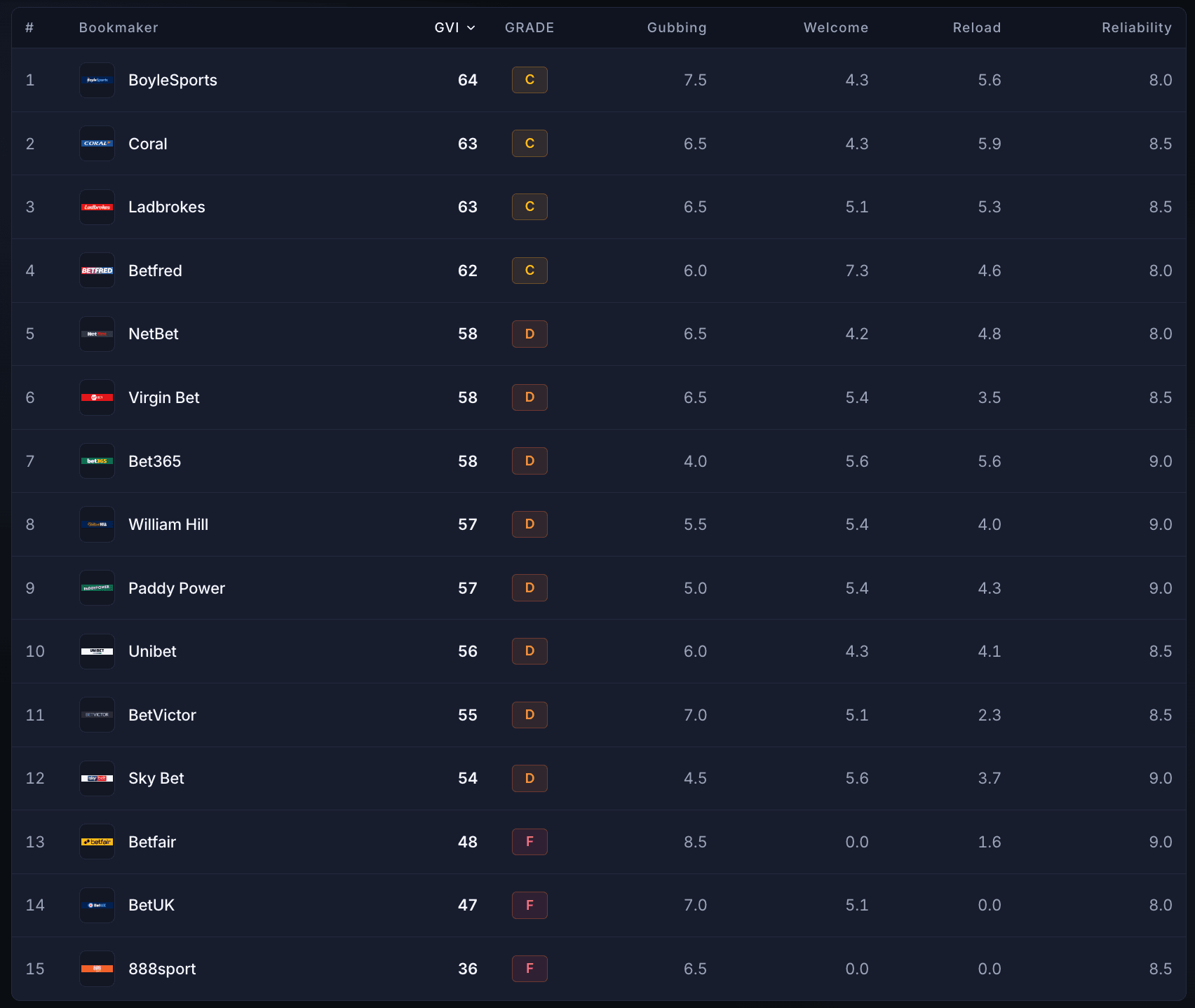
The Gubbing & Value Index at launch: fifteen UK bookmakers, ranked by composite score, sortable by any component.
What we found in the launch cohort
The clearest pattern in the data is that no UK bookmaker is good on every dimension at once. The top of the table is full of operators who score well on one or two components and middling on the rest; nobody breaks 70.
BoyleSports leads at GVI 64 (C). That sits oddly with the operator's well-known reputation for fast restrictions. Community gubbing lists frequently include it under "extract value quickly". The reason it tops the index is that strong reload cadence (5.6/10) and a generous welcome offer combine with the highest manual gubbing-risk score in our cohort outside the exchange-led brands. The advice on the BoyleSports hub page is consistent with this: members are advised to compress welcome-offer extraction into the first weekend rather than treating it as a long-term reload home.
Coral and Ladbrokes are tied at 63 (C, joint-second). Both sit under Entain plc's LC International Limited (UKGC licence 54743), which means behaviour at one brand feeds the connected-account profile at the other. Their component breakdowns are nearly identical. The difference of one position is the rank tie-break by gubbing-risk, where Coral edges slightly higher on the manual score. Same operator, same back-end risk model, same caveats. Reading the Coral and Ladbrokes hubs together is the most useful way to understand the Entain cluster.
Betfred (GVI 62) carries the strongest welcome-offer score in the cohort at 7.3/10: the £50 welcome offer in our data window converts to roughly £34 of estimated EV, the highest of any UK operator we cover. The flip side: members report horse-racing arbitrage being the fastest known restriction trigger at this operator, which is unusual specificity. The Betfred hub page has the detail. Worth noting because it's a use-case signal that doesn't show up in the composite: the GVI rates Betfred well overall, but if your strategy concentrates on horse-racing offers, the actual longevity at this operator may be shorter than the headline 6.0/10 gubbing-risk score suggests.
Bet365 ranks seventh at GVI 58 (D), which will surprise readers who expect the largest UK sportsbook to top a matched-betting index. It doesn't, for the same reason its reputation among matched bettors is what it is: gubbing risk scores 4.0/10, the lowest in the cohort. Reliability and reload cadence both score 5.6+, so the composite still lands in the D band, but the ceiling is structural, not a data quirk. A profitable Bet365 account is unlikely to remain unrestricted for long, and the GVI captures that honestly. Same dynamic at Sky Bet (GVI 54), Paddy Power (57), and to a lesser extent William Hill (57): the Flutter and Evoke clusters sit in the lower half of the table because their gubbing-risk scores cap their upside.
Betfair is the most interesting edge case. Our composite rates it F (48), the third-lowest score in the cohort, but the underlying picture is split. The Sportsbook (the licensed bookmaker side) gubs like its Flutter siblings; the Exchange (the peer-to-peer venue) doesn't close winning accounts as a matter of policy and is the standard lay venue for almost every UK matched bettor. Our GVI applies at the brand level, which means the Exchange's structural tolerance of winners shows up as the highest gubbing-risk component score in the entire cohort (8.5), but the missing welcome offer in our 90-day window and the very low Sportsbook reload activity drag the composite to F. The Betfair hub page explains the dual-product reality in detail.
888sport and BetUK score F (36 and 47) for similar structural reasons: neither has had a meaningful reload pipeline in our 90-day window, which dominates the composite. Their gubbing-risk scores (6.5 and 7.0 respectively) are perfectly reasonable. If reloads return at either operator, the composite will rise sharply at the next snapshot. This is the kind of detail a methodology-anchored ranking surfaces and a marketing-anchored ranking would obscure.
What GVI is not
GVI is narrow by design. It scores one specific use case (matched betting) and does so against the bookmakers in our active scraper coverage. It does not capture product breadth beyond matched-betting-relevant markets, mobile app quality, customer-service experience for non-matched-betting users, or recreational-bettor value. The same operator that gubs profitable accounts may be excellent for a casual once-a-week bettor.
The score is also not a recommendation to gamble. UK Gambling Commission–licensed operators must be 18+, must include the standard responsible-gambling messaging, and gambling can be addictive. See GambleAware and BeGambleAware for support. We publish GVI to help readers who have already decided to engage with matched betting (a lawful, tax-free side activity in the UK) make a more informed bookmaker choice, not to encourage anyone to start.
How we'll keep it honest
Three commitments. First, the methodology stays public and versioned: the formula, the component anchors, the weighting rationale, and the rubric all live at /bookmakers/methodology, with edits tracked in git. Second, snapshots are monthly and never overwritten, so trend lines per bookmaker remain visible over time. Third, the manual reliability scores are reviewed quarterly by the bookmaker-coverage editor, and updated mid-quarter when material events occur (UKGC settlements, payment-processor changes, mass account-restriction waves). Members, journalists, and competing analysts can audit the full chain by reading the methodology, the per-bookmaker hubs, and the public scoring engine.
Where to find each bookmaker's rating
Each bookmaker has its own hub page with the full editorial profile (gubbing-risk pattern, cluster-10 advice, T&Cs change log, reliability notes, related guides). Direct links to all fifteen, in current GVI order:
- BoyleSports (64, C); Coral (63, C); Ladbrokes (63, C); Betfred (62, C); NetBet (58, D); Virgin Bet (58, D); Bet365 (58, D); William Hill (57, D); Paddy Power (57, D); Unibet (56, D); BetVictor (55, D); Sky Bet (54, D); Betfair (48, F); BetUK (47, F); 888sport (36, F).
External references underpinning the methodology: the UKGC public licensee register (every operator's licence number is verifiable there) and the ASA matched-betting advice page (which we cite in our legality post for the rulings against banned advertising language).
The practical takeaway
If you're new to matched betting, the GVI is the layer that didn't used to exist: a way to decide which bookmakers to start with on more than just "they have a welcome offer". Pick the high-GVI bookmakers first if you want longer account lifetimes; pick the high-welcome-offer bookmakers first if you want fast extraction and don't mind cycling through accounts. Both strategies are valid; both are now visible.
The tutorial walks you through the welcome offer at every operator on the list, with the lay leg covering the downside. Reload-offer EVs and a per-bookmaker oddsmatcher filter are part of Premium, but the index itself, the methodology, and the per-bookmaker hub pages are public and will stay that way. We'd rather a reader audit our analysis than take it on trust.
Matched betting is for adults aged 18 and over. If gambling stops feeling fun, free confidential support is available at GambleAware.