Each-Way Matched Betting Explained: A Beginner's Guide with Worked Examples (2026)
Each-way matched betting is a single each-way bet at the bookmaker laid as two separate exchange bets, one on the win market and one on the place market. Done on a normal each-way bet it sits close to flat; done on an extra-place promotion it's where most of the profit in this corner of matched betting actually lives.
Most beginners attempt their first each-way matched bet on a short-priced favourite and lose money. The maths only really works on longer odds in bigger fields, and the real lever is the extra-place promotion stacked on top.
Place terms and extra-place promotions change weekly. Always check the bookmaker's live offer page before betting. Last verified: 2026-05-22.
Summary
- An each-way bet is two stakes stapled together: half on the horse winning, half on it placing. The place leg settles at a fraction of the win odds, usually 1/4 or 1/5.
- To matched-bet one you lay both legs at the exchange: the win on the win market, the place on the place market.
- Place markets are thinner than win markets. Check the place lay liability before placing, not after.
- Vanilla each-way matched bets typically return 0–5% of the outlay. Rarely worth the time unless the place lay has drifted in your favour.
- Extra-place each-way bets, where the bookmaker pays more places than the exchange covers, return 8–20%. That's the actual profit lever in this cluster.
- Use the each-way calculator for the standard version and the extra-place calculator for promotion-driven races.
- Profits are tax-free in the UK: HMRC treats them as gambling winnings with nothing to declare.
What is an each-way bet?
An each-way bet at a bookmaker is two bets stapled together. Half of your stake goes on the horse winning the race outright. The other half goes on it finishing inside the bookmaker's stated number of places, with the place leg settled at a fraction of the win odds. The standard UK fraction is 1/5, with 1/4 still used on smaller fields and a few non-handicap races.
Default place terms follow the British Horseracing Authority's race-size rules: races of 5 to 7 runners pay 2 places at 1/4 odds, 8 to 15 runner handicaps pay 3 places at 1/5, and handicaps of 16 or more runners pay 4 or 5 places at 1/5. The canonical breakdown sits on the British Horseracing Authority's race rules pages. Bookmakers sometimes pay extra places on top of those defaults, which is the extra-place offer and the part that matters most for matched betting.
A £10 each-way bet is therefore a £20 outlay, because the win and place legs are separate stakes pooled into one slip. That's the first thing most beginners miss.
What does matching an each-way bet mean?
Matched-betting an each-way bet means laying both legs at the exchange. The win leg is laid on the standard win market, the same one you'd use for any back-and-lay qualifier. The place leg is laid on the place market, a separate market the exchange runs in parallel for each race.
Lay betting sits at the heart of matched betting because the lay cancels the bookmaker's bet. The awkward leg here is the place lay: place markets are thinner than win markets, sometimes much thinner on a small Saturday handicap where every horse is a 14/1 outsider and almost nobody wants to take the trade.
Two lays mean two liabilities, both held upfront. For a £10 each-way bet at 10/1 that's typically a £90+ win-lay liability plus a £25–£35 place-lay liability sitting in your Smarkets or Betfair wallet until the race settles. Most newcomers find out about that the first time they try the bet on a £40 exchange balance.
Worked example: a £10 each-way bet at 10/1
The clearest way to see the structure is to walk one bet through end to end. Take a 10/1 outsider in a 16-runner handicap. The bookmaker is offering 5 places at 1/5 odds. The decimal win price is 11.0, and the implied place price (1/5 of 10/1, plus 1) is 3.0. Lay quotes at Smarkets are sitting at 11.5 on the win and 3.2 on the place.
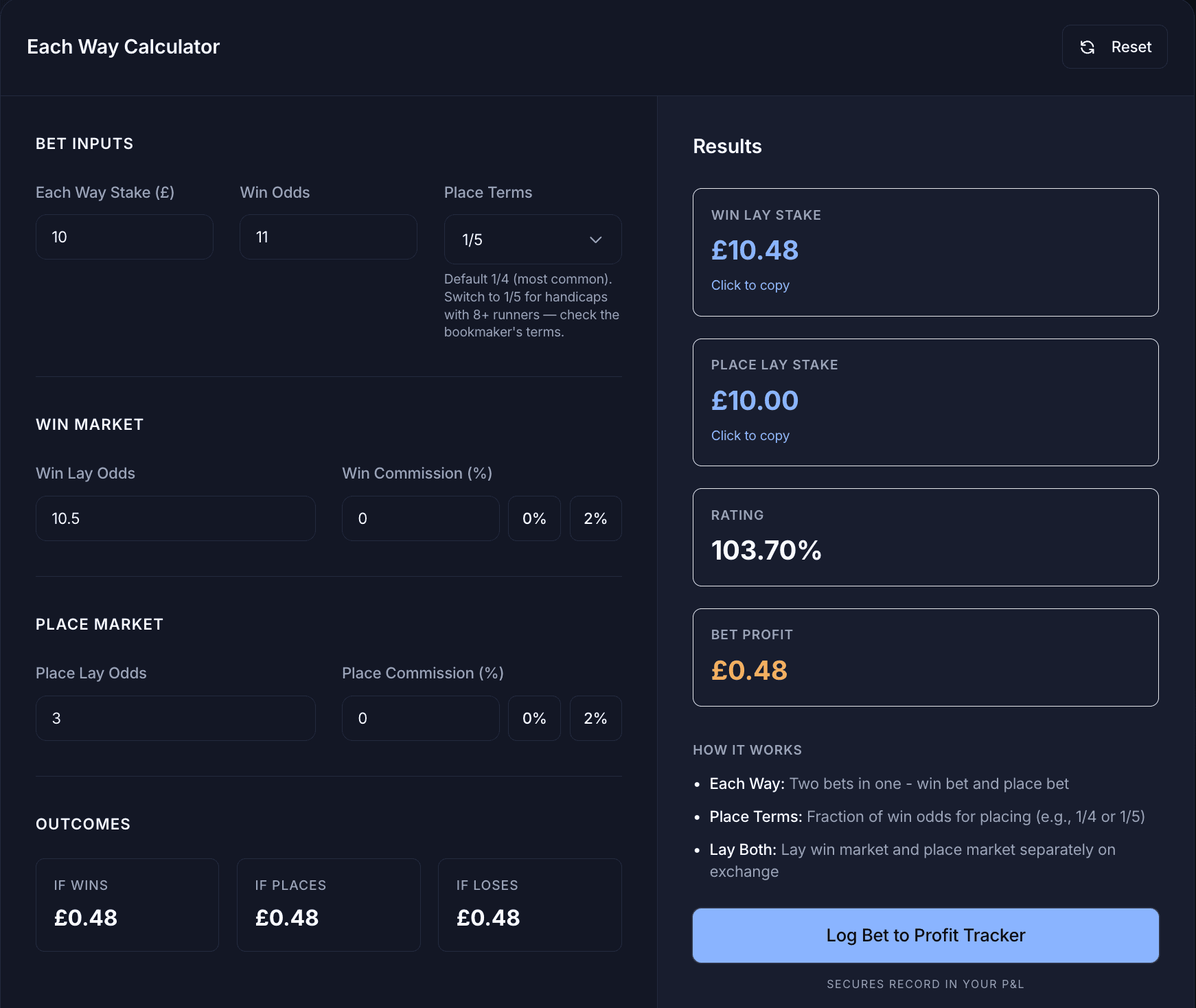
Better Bet each-way calculator showing a £10 each-way bet at 10/1 with 1/5 place terms, two lay stakes computed and the per-outcome P/L for all three branches
Drop the numbers into the each-way calculator with the back stake at £10 each-way, the back and lay odds for both legs, and Smarkets at 2%. The calculator returns two lay stakes and the per-outcome P/L.
Worked example
Branch 1: the horse wins. The bookmaker pays out on both legs. The win lay loses (paying out its liability to the backer at the exchange), and the place lay also loses (because winning counts as placing). Net position: a small positive of around £0.20–£1.50 once the lay stakes are sized correctly.
Branch 2: the horse places without winning. The bookmaker pays out on the place leg only. The win lay wins (the horse didn't win), the place lay loses (the horse placed). Net position: roughly the same small positive as branch 1.
Branch 3: the horse finishes outside the places. Both bookmaker legs lose. Both lays win, minus exchange commission. Net position: again a small positive, in the same narrow range.
The three branches don't land at identical numbers. That's normal for each-way: the place leg's overlap with the win leg means the maths can't be perfectly flat across all three. The conversion on a vanilla each-way matched bet typically sits at 0–5% of the £20 outlay, which is why most experienced matched bettors skip the vanilla version entirely and wait for the extra-place variant.
What decides whether the bet is worth placing is the gap between the place back at the bookmaker and the place lay at the exchange. On a 10/1 win price with 1/5 terms the back place is 3.0 and the exchange place market often sits at 3.1 to 3.4. A lay drifting by two ticks can flip the bet from mildly positive to mildly negative, which is why matching the lay first is the safer routing.
Where the real profit comes from: extra-place promotions
The vanilla version is a warm-up. The lever is the extra-place promo.
An extra-place offer pays more places than the standard BHA-mandated terms. A 16-runner handicap that would normally pay 5 places might pay 6 under Paddy Power's or Coral's Saturday extras. The exchange still only lays 5, so the sixth position is uncovered: if your horse finishes 6th, the bookmaker pays the place leg and neither lay loses.
That uncovered position is where the real profit comes from. Run the same 10/1 horse through the extra-place calculator with 5 lay places against 6 bookmaker places and the predicted conversion typically comes back at 10–15% of the each-way stake. Across a Saturday of qualifying races a steady extra-place run can extract £20–£60. Today's extra-place races is the live list. Royal Ascot is the same setup at scale, which is why our Royal Ascot 2026 guide leans on this calculator throughout.
I first ran an extra-place position on a 16-runner Saturday handicap at York in late 2018, six months into matched betting. The calculator predicted £4.20 of conversion on a £10 each-way bet. The place lay drifted from 2.95 to 3.20 in the ten minutes between me clicking "place bet" at the bookie and getting the lay matched on Betfair. Final result: £1.70, not £4.20. That's the discipline of the place market. Get the lay matched first if you can, or have both screens open and click fast.
UK bookmaker each-way variation table
The default position is uniform across the UK majors: 1/5 odds on the place leg, BHA-standard places by race size. The volatile column is the extra-place promo, which is where the bookmakers compete and where most of the matched-betting value sits. The table below is verified against our UK bookmaker hub as of 2026-05-22. The extra-place column moves weekly, so check the live bookmaker page before placing a bet.
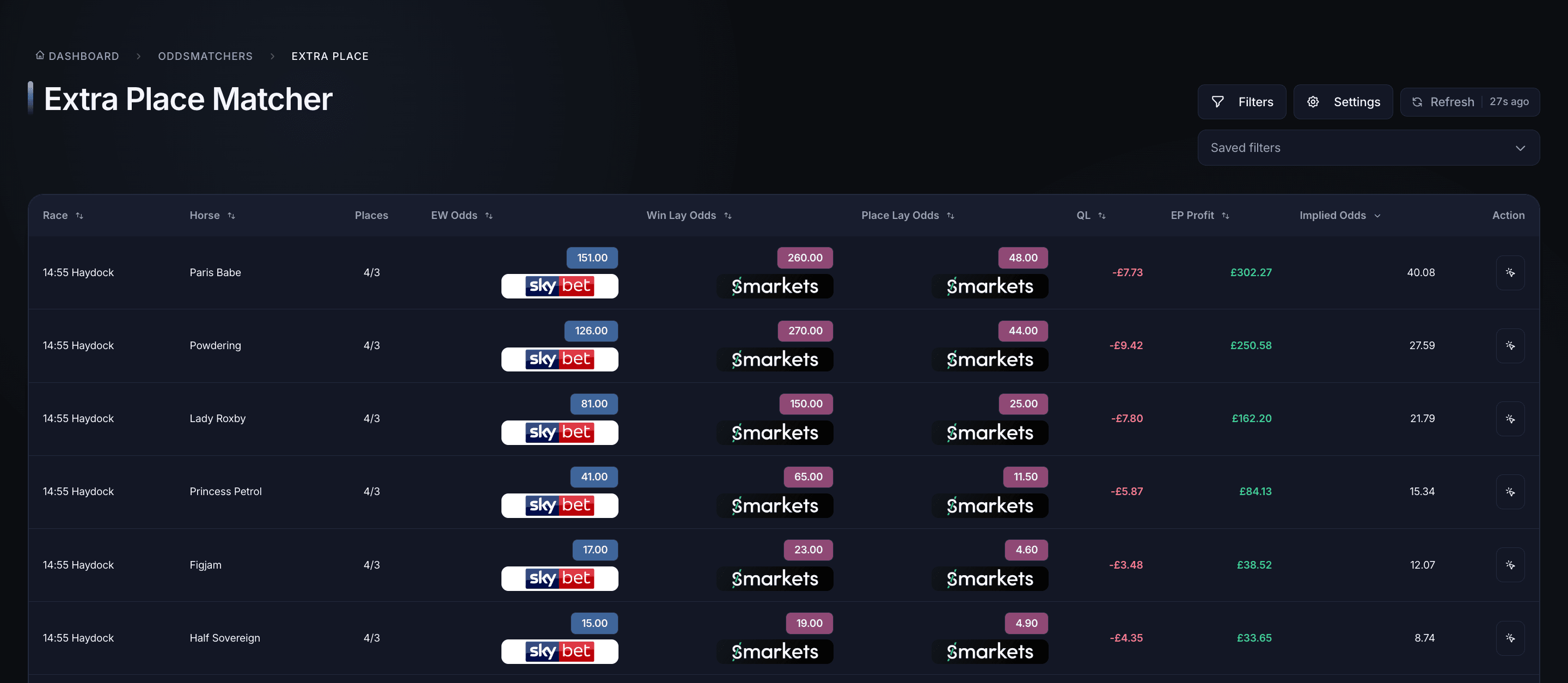
Better Bet extra-place oddsmatcher showing today's live extra-place races ranked by conversion rate, with bookmaker and exchange place counts visible
| Bookmaker | Default place terms | Extra-place promos | Place market depth (exchange) |
|---|---|---|---|
| Bet365 | 1/5, BHA standard | Rare, mainly festival meetings | Liquid for most racing |
| William Hill | 1/5, BHA standard | Saturday handicaps | Mid |
| Sky Bet | 1/5, BHA standard | Frequent Saturday extras | Mid |
| Paddy Power | 1/5, BHA standard | Most Saturdays + festival majors | Liquid on majors |
| Coral | 1/5, BHA standard | Weekly handicap extras | Mid |
| Ladbrokes | 1/5, BHA standard | Mirrors Coral most weeks | Mid |
| Betfair Sportsbook | 1/5, BHA standard | Occasional | Liquid (Exchange next door) |
| BetVictor | 1/5, BHA standard | Festival extras only | Thin |
Paddy Power and Coral are the workhorses of this cluster, running extra-place promos on most Saturday handicaps. Bet365 leans rare-but-deep on the bigger meetings, and BetVictor's exchange place markets can be thin enough that the trade isn't worth attempting unless you're confident the lay will match cleanly. The Advertising Standards Authority's matched-betting guidance is the right place to look if a promo's wording feels stretched.
Why short-priced favourites don't work
This is the section most each-way explainers skip. The intuition is straightforward once you see it: at short odds the place lay sits at almost the same price as the place back, and there's no spread for the bet to exploit.
A 5/2 favourite in an 8-runner handicap is a typical "looks safe" each-way pick. The win price is 3.5 decimal, the place price (1/5 of 5/2, plus 1) is 1.5 decimal, and the exchange place market usually quotes 1.5 to 1.55. There is no gap, the lay liability eats whatever value the place back had, and the net result is reliably negative.
The sweet spot is 8/1 to 20/1 in handicap races with 16 or more runners on 1/5 terms. At those prices the implied probability of placing sits in the 25–40% range, and the exchange place market typically prices that probability higher than the bookmaker does because 14/1 outsiders attract very few layers. That price gap is where the bet earns its money, vanilla or extra-place.
Common mistakes
Common mistake
The five errors I see most often on newcomers' first each-way screenshots.
- Treating £10 each-way as a £10 outlay. It's £20. Plan the bankroll accordingly.
- Confusing 1/4 and 1/5 place terms. The calculator handles both, but only if the right box is ticked.
- Placing the bookmaker bet first then hunting the lay. On a thin place market the price will have drifted by the time you click. Match the lay first, or have both windows open and place them within seconds.
- Treating vanilla each-way as a profit method. It's roughly flat. The extra-place version is the lever.
- Forgetting to check exchange liquidity. The place market on a small Saturday card can be £40 deep, so a £13 lay stake will move the price.
Frequently asked questions
Is each-way matched betting profitable?
On vanilla each-way bets it's usually flat to marginally positive: typically 0–5% of the £20 outlay. On extra-place promotions the conversion runs 8–20% of the each-way stake, sometimes higher on small fields. The profit lives in the extra-place version, not the vanilla one.
What's an extra-place each-way bet?
A bet on a race where the bookmaker pays more places than the standard BHA terms: six places when the race normally pays five, or eight at a golf major against five at the exchange. The extra position isn't covered by the exchange's place market, which is where the conversion comes from. The extra-place oddsmatcher shows the live races that qualify.
What odds should I look for?
Eight to twenty to one in handicap races of 16 or more runners on 1/5 place terms. Short-priced favourites don't work because the place market sits at the same price as the place back, leaving no spread to exploit.
Can I use the standard calculator instead?
No. The each-way calculator handles both lay legs at once, with the place leg priced at the right fraction of the win. The standard matched betting calculator only handles one lay, and the place fraction has to be worked out by hand, which is where most manual mistakes start.
Are each-way profits tax-free in the UK?
Yes. HMRC treats matched-betting profits as gambling winnings, which aren't taxable income in the UK. Our full tax guide covers the detail. The Gambling Commission's LCCP handles the regulatory side; tax sits with HMRC.
What about each-way bets on football or golf?
Same mechanics, different markets. Golf each-way is genuinely useful: major tournaments routinely pay 8 places against an exchange that lays 5 or 6. Football each-way is rare, shows up mainly on top-goalscorer markets, and the exchange liquidity usually isn't there.
The practical takeaway
Each-way matched betting is the natural second profit lever after standard back-and-lay qualifiers, but the maths only really sings on extra-place promotions. Stick to the vanilla version while you're learning the routing, then switch to extra-place races for the actual money once the calculator output and the lay sequencing feel routine.
If you're not signed up yet, the tutorial walks through standard back-and-lay before introducing each-way and extra-place, and both calculators are free to use either way. GambleAware is the right port of call if any of this starts feeling less like maths and more like gambling.